Did Isaias put salt water in your yard? What it means for trees
Salt water from a storm surge can keep hurting trees long after the water goes back down. Here’s what it does, what to watch for this winter and what helps.
· H&L Services of NW Florida
Isaias came ashore near Destin on October 9 with sustained winds of 105 mph.1 Most of the talk since then has been about wind. On the coast there’s a second, slower problem. If surge water got into your yard, the salt it left behind can keep stressing trees for months.
Here’s what that salt does, what to look for this winter and what actually helps.
01
How much surge did Isaias bring here?
The National Weather Service office in Tallahassee says surge and heavy surf caused beach erosion, seawall damage, overwashed coastal roads and damaged boardwalks in Walton, Bay, Gulf and Franklin counties.2 The tide gauge at Panama City Beach Pier peaked at 5.60 feet above mean higher high water. That’s its second highest reading on record, behind Hurricane Opal in 1995.2 The Apalachicola gauge peaked at 3.58 feet on the same scale.2 Mean higher high water is the average height of the highest tide each day, so those numbers measure how far the water rose above a normal high tide.
A gauge only tells you about one spot. Whether your own yard flooded depends on your elevation and how close you are to the bay or the Gulf.
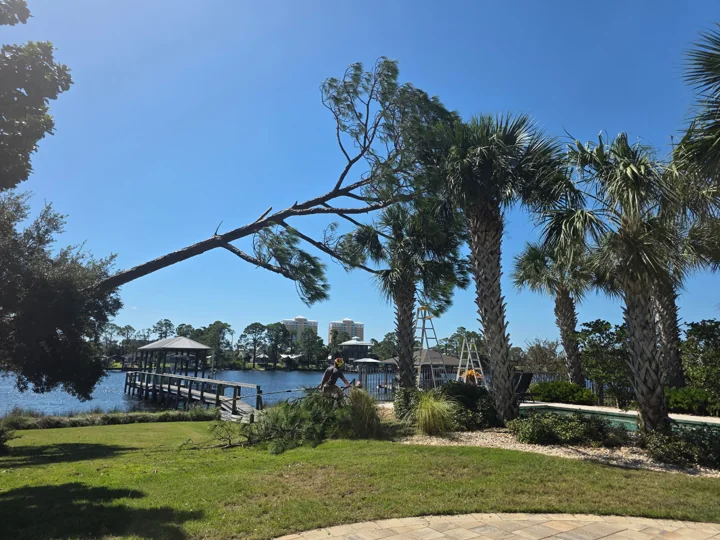
H&L clearing a storm-damaged pine from a waterfront yard after Isaias.02
What salt does to a tree
Salt in the soil makes it harder for roots to pull in water. UF/IFAS explains that plants in salty soil can wilt even when there’s plenty of water around them.3 Sodium and chloride can also build up inside the plant, and at high enough levels that causes symptoms ranging from leaf burn to dead tissue.3
UF/IFAS’s 2026 guide to restoring trees after a hurricane puts it plainly. Significant tree dieback from salt damage can happen in coastal areas that get storm surge.4 The Sarasota County Extension office goes further for landscape plants. It says most plants hit by saltwater flooding won’t survive, and that even native coastal plants that handle salt spray can’t tolerate being under salt water.5
Timing matters too. A Pinellas County Extension agent notes that salt gets more concentrated as flooded soil dries out, and that rain afterward helps by diluting it.6 That’s worth keeping in mind this fall. October was a very wet month in Apalachicola overall.1 But the Weather Service recorded no rain after October 10 for the rest of the month,1 so yards that flooded had a dry few weeks right after the surge.
03
Signs to watch for this winter
Salt damage often looks like drought, even in a yard that’s had plenty of water. Things to look for:
Some trees cope better than others. UF/IFAS Extension in Charlotte County lists live oak among the salt tolerant trees.7 Pines deserve a close watch too, because a pine that browns out completely almost never comes back.4 There’s more on that below.
Fresh water is the main tool. UF/IFAS says the only way to get salt out of the soil is to leach it out of the root zone with plenty of water, from irrigation or rain.3 The hurricane recovery guide says trees in surge areas may need flushing with water for the same reason.4 Sarasota’s extension office suggests watering plants that still show signs of life with fresh water.5 Check with your water provider or the Northwest Florida Water Management District for any watering limits before you run sprinklers hard, since UF/IFAS notes those rules can limit how much flushing is practical.3
Be careful where that water comes from. If you irrigate from a pond or shallow well that took on surge water, you could be putting salt right back. Bay County Extension describes a Niceville neighborhood whose shared irrigation pond flooded with salt water from the bay during Hurricane Ivan.8 When salt is suspected, the same office suggests a temporary, targeted rinse with household water instead.8 The same office notes that the UF/IFAS lab can test soil and water for salt using electrical conductivity.8
A few things to skip for now:
Fertilizer. Most fertilizers deliver nutrients in salt form, so Sarasota’s extension office advises against chemical fertilizer on salt-stressed plants.5 Pinellas’s agent also says to hold off on fertilizing in areas that flooded.6
Heavy pruning. UF/IFAS says major pruning to change a tree’s structure shouldn’t happen right after a hurricane.4 Extra cutting adds stress to plants that are already weak.5 Broken or hanging limbs over a house, driveway or walkway are a different matter and are worth dealing with now.4
New planting in flooded spots. The Pinellas agent recommends waiting to plant where salt water stood until weeds and other plants start coming back on their own.6
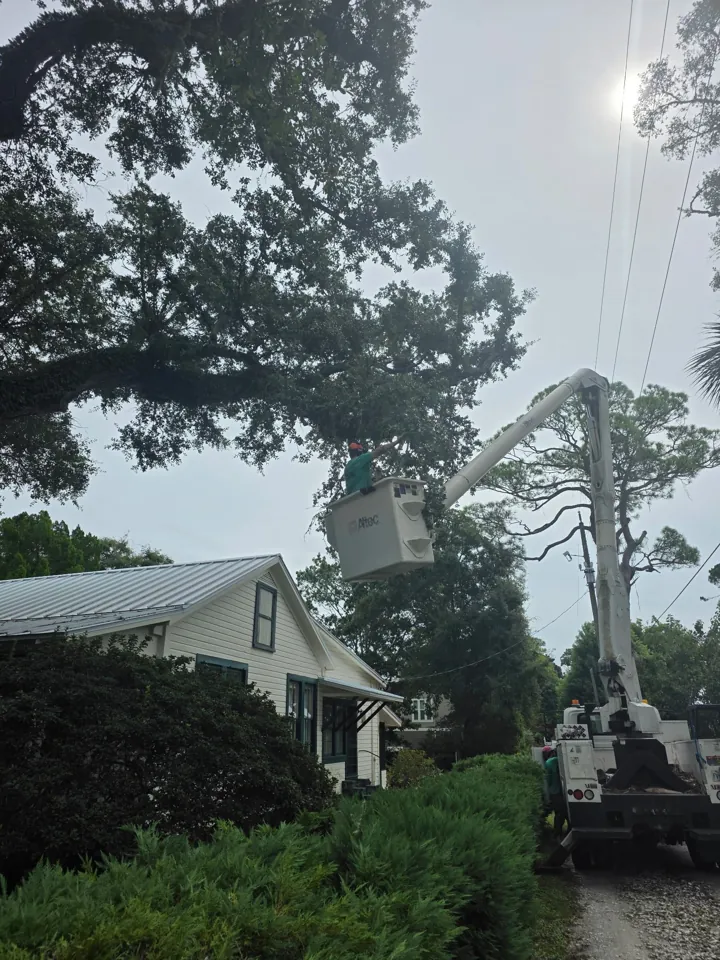
Trimming a large oak from a bucket truck. Save structural pruning on salt-stressed trees for later.05
When to decide on removal
This is the hard part, because the honest answer is to wait. UF/IFAS advises waiting until the spring after a hurricane before deciding a tree is dead.4 If a tree hasn’t sprouted by spring or early summer, it’s not likely to recover.4 Things may look worse before they look better.5
The exception is pines. UF/IFAS says a pine with all brown needles, or no needles at all, is dead.4 The guide notes some exceptions, such as pitch pine, which can resprout after losing its needles.4 A dead pine near a home, a fence or a road shouldn’t wait for spring. The same goes for any tree with a split trunk, a large hanging limb or a new lean.
If you’re watching a tree that took on salt water and want a second set of eyes, or a pine has gone brown, we’re happy to come take a look. You can read more about our storm damage cleanup and tree removal work, or call us at (850) 323-1269.
This post is general information for homeowners in Northwest Florida. It isn’t legal advice or a substitute for an on-site look at your tree. Rules, prices and programs change, so confirm anything time-sensitive with the source listed above.