Some trees show storm damage right away. Others look fine for months and then start to fail. Here’s what to look for in your yard and when it’s worth having someone take a closer look.
· H&L Services of NW Florida
Isaias came ashore near Destin on the night of October 9.1 Nearly a month later, most of the obvious damage has been cut up and hauled off. The trees worth thinking about now are the ones still standing.
Storm stress doesn’t always show up right away. The Florida Forest Service notes that hidden wind damage can lead to decline and death for months or even years after a hurricane.2 So a tree that came through Isaias looking fine is worth a second look this fall.
01
Start with a walk around the tree
You can spot most warning signs from the ground. InspecTree’s guide to whether a tree needs to come down pulls together the signs that university extension services tell homeowners to watch for:3
Dead or dying limbs
Cracks in the trunk or where big limbs fork
A trunk that leans or tilts instead of growing upright
Cavities in the trunk or at the base
Mushrooms, conks or other fungus on the bark or around the base
Cankers or open wounds in the bark
Cracks in the soil near the base
Sawdust or crumbling wood piled at the base
The same guide makes a point we agree with: decay inside the trunk and damage to the roots are hard to see from outside.3 If a tree could hit your house or someone in your family when it fails, a close look from a professional is worth it.
02
When storm damage usually means removal
UF/IFAS Extension publishes a guide written for this exact situation in Florida. It lists the conditions where UF/IFAS says a damaged tree should be removed:4
The lower main trunk is cracked or broken
More than half the canopy is gone, including the main leader, with several broken stems
Most of the canopy is damaged because large branches over 8 inches thick have broken
The tree is leaning and likely to fall on a person, house, power line or road
Major roots were severed or broken
UF/IFAS says a leaning tree that could hit something should come down right after the storm, and that any leaning tree should have its roots checked for breakage, exposure or lifting.4
UF/IFAS also advises against trying to stand a big tree back up. Trunks under 4 inches across can be stood up and staked, but for anything over 8 inches it’s not recommended because the tree is likely to become a hazard later.4
03
Pines: why waiting a few months makes sense
Pines are some of the hardest trees to judge right after a storm. UF/IFAS says pines often die over a period of 6 months to 2 years after a windstorm, and that pines with 30 to 50 percent of their canopy damaged may be beyond recovery. A pine with all brown needles is dead and should come down.4
Stressed pines also attract bark beetles. The Florida Forest Service expects Ips engravers and black turpentine beetles to build up in the months and years after a hurricane, and lists three signs to watch for:2
Pitch tubes, which are small clumps of resin on the bark
Reddish-brown boring dust
Needles that wilt quickly
If you see those on a pine near your house, have someone look at it sooner rather than later.
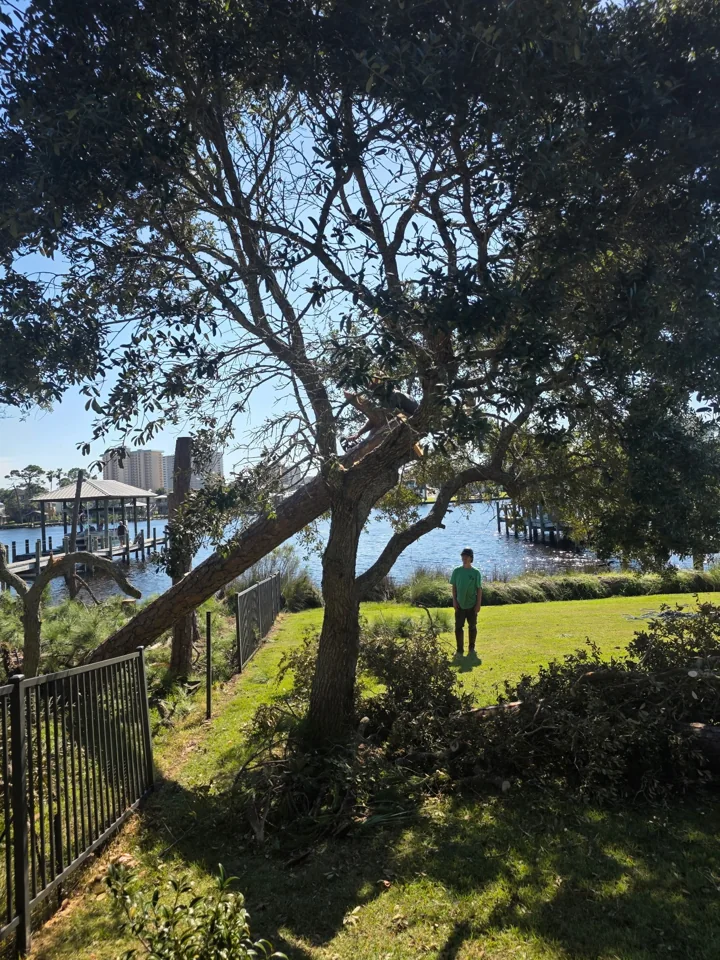
A broken pine across a waterfront yard after Isaias.04
Palms and oaks
Palms follow different rules. According to UF/IFAS, a palm with a trunk snapped in half is dead, and a single-trunk palm whose bud was destroyed won’t recover. On a palm that’s still standing, it’s often hard to tell whether the bud was damaged. In that case UF/IFAS suggests giving it at least 6 months to push out new growth before deciding.4 Our palm care page covers trimming and removal if it comes to that.
Oaks vary a lot by species. UF/IFAS lists live oaks as good at walling off decay, which makes them easier to restore, though a live oak that lost 50 to 70 percent of its canopy may be beyond recovery. Laurel oaks and water oaks are much weaker at it, and decay becomes more common in laurel oaks as they reach about 40 years old.4
05
What you can leave alone
Not every storm-damaged tree needs work. UF/IFAS says a tree that was healthy before the storm and only lost its leaves, with no major branch breakage, doesn’t need any special treatment.4 Broken branches under 4 inches across can usually be pruned out.4
One thing to avoid is topping, where the crown gets cut back to stubs. UF/IFAS calls it a poor pruning practice that should be avoided.4 If a tree needs cleanup more than removal, see our trimming and pruning page.
Stay off the saw. UF/IFAS recommends leaving chainsaw work on storm-damaged trees to professionals, watching for broken limbs hung up overhead, calling the power company about limbs on or over lines, and leaving any work near power lines to qualified line-clearance arborists.4
Check the permit rules. Inside Apalachicola city limits, tree removal goes through the City’s permit process. Our local permit guide walks through it.
Know the state hazard-tree rule. Under Section 163.045 of the Florida Statutes, a local government can’t require a notice, application, permit, fee, mitigation or replanting to prune or remove a tree at a detached single-family home when the owner has documentation that the tree poses an unacceptable risk.5 That documentation has to be an onsite assessment done to ISA tree risk standards and signed by an ISA certified arborist or a Florida-licensed landscape architect. The rule doesn’t override mangrove protections.5 InspecTree suggests asking for that finding in writing if you think a tree qualifies,3 and it’s still worth asking the City how the rule applies to your property.
If you’ve got a tree you aren’t sure about, we’re happy to come look at it. We’ll tell you plainly whether we think it should stay or go, and give you a free quote either way.
This post is general information for homeowners in Northwest Florida. It isn’t legal advice or a substitute for an on-site look at your tree. Rules, prices and programs change, so confirm anything time-sensitive with the source listed above.