Lethal bronzing in palms: what to look for and what to do
Lethal bronzing has been killing palms in Apalachicola since at least 2022. Here’s how the disease shows up, why a sick palm can’t be saved, and what you can do for the healthy ones.
· H&L Services of NW Florida
If you’ve noticed a cabbage palm in town turning a rusty brown from the bottom up, there’s a good chance you’ve seen lethal bronzing. It’s a palm disease that showed up in Florida in 2006 and has since been confirmed in more than 30 counties.1 It reached Apalachicola a few years ago, and in September 2025 a City commissioner reported it was spreading throughout town.2
There’s no cure for a palm that has it. What you can do is recognize it early, get the sick palm out before it spreads, and protect the healthy palms nearby.
01
How it got here
The Franklin County Extension office sent a palm tissue sample to a UF lab in 2022, and the test came back positive for the lethal bronzing pathogen.1 The Apalachicola Times reported that the first confirmed case was a sabal palm along the highway by Mt. Zion Baptist Church at U.S. 98 and Eighth Street.3 By early 2024 the City’s tree committee chairman said about 50 trees showing symptoms had been identified, and the City had been removing infected palms on city property.3
That’s a big deal on this part of the coast. The sabal palm (also called cabbage palm) is a native Florida palm, and UF/IFAS Extension says the disease is quite capable of infecting and killing it.1 Other palms planted around here are also hosts, including Canary Island date, pindo, Chinese fan and Bismarck palms.1
02
What causes it and how it spreads
Lethal bronzing is caused by a phytoplasma. That’s a bacterium without a cell wall that lives in the palm’s sap.4 It’s related to the organism behind lethal yellowing, but it’s a different pathogen.4
It moves from palm to palm in a small planthopper called Haplaxius crudus. The insect picks up the pathogen by feeding on an infected palm, then passes it on when it feeds on a healthy one.1 The pathogen can’t survive outside a host, so it isn’t carried mechanically.4 Duval County Extension notes that pruning tools don’t spread this disease.5
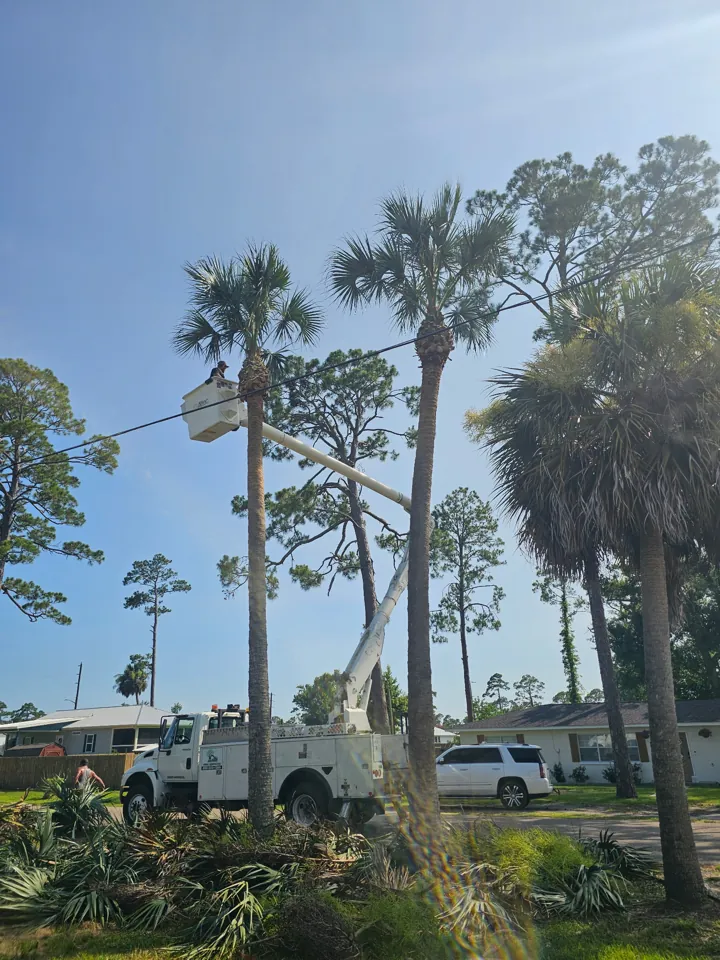
Sabal palms like these are a host for lethal bronzing.03
The signs, in order
The disease follows a fairly predictable path. UF/IFAS describes it like this:4
Fruit drops or flower stalks die. If the palm is carrying fruit, it drops early. If it hasn’t set fruit yet, the flower stalks die. This early sign is easy to miss on young palms or palms whose flower stalks have been trimmed.4
The oldest fronds discolor. The bottom leaves change color first, and the discoloration works its way up to the younger leaves.
The spear leaf collapses. That’s the new unopened frond in the center. When it dies, the palm’s growing point is dead and the palm can’t be saved.
The color is the clue in the name. Dying fronds turn bronze instead of the tan or gray you’d see when a palm drops old leaves normally.1 Not every palm reads the textbook, though. Some skip the leaf discoloration entirely, and the spear leaf just collapses.4
Timing matters too. UF/IFAS puts the gap between infection and the first symptoms at about four to five months, then roughly two to three more months until the spear leaf collapses, though that varies a lot from palm to palm.4 That means a palm can be carrying the disease for months while it still looks healthy.
Because these symptoms look like other palm problems, testing is recommended. The sample is sawdust drilled from the trunk, and it goes to the UF Plant Disease Diagnostic Center for testing.5 In 2022 the Franklin County Extension office listed the UF lab test at $75.1 Call the extension office for the current process and fee.
04
Why an infected palm has to come out
Once a palm shows symptoms or tests positive, UF/IFAS considers it lost and says it should be removed right away. The longer it stands, the more chance the insects carry the disease to other palms.4 That goes for a palm that tests positive but still looks fine, since treatment wouldn’t act fast enough to keep it from getting sick.4
It’s a hard call when the palm is a big old sabal that frames your porch. But leaving it up doesn’t save it, and it puts every other palm on the block at risk. If you have a palm that’s showing these signs, our palm care and tree removal crews can come take a look and quote the removal.
05
Protecting the healthy palms
There is a preventive treatment. An antibiotic called oxytetracycline (OTC) is injected into healthy palms that have tested negative. UF/IFAS recommends injections every three to four months for at least two years.4 It doesn’t reverse symptoms in a palm that’s already sick.4
A few things worth knowing before you start:
OTC only protects the palm that gets the injection.5
Each injection leaves a wound that palms don’t heal, and new drill sites are needed every three or four treatments.5
Duval County Extension says any palm species removed because of lethal bronzing can be planted back in the landscape.5
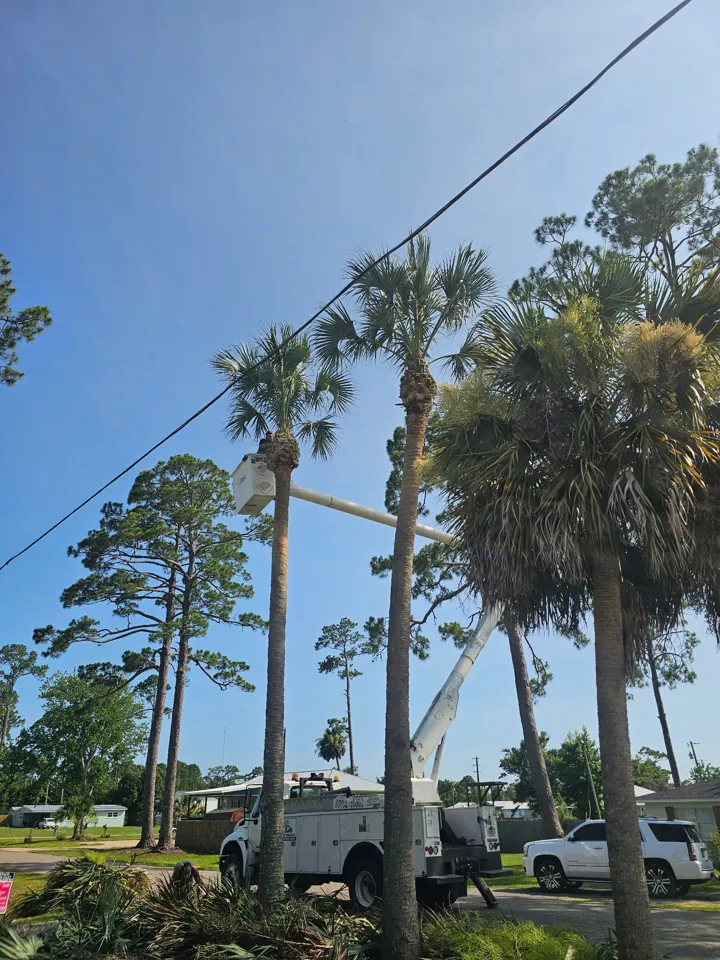
H&L palm work on a residential street.06
Removing a palm inside Apalachicola
Apalachicola has made this a little easier on homeowners. At a September 3, 2025 meeting the City Commission voted 4 to 1 to waive the tree permit fee for diseased palms, share information about the disease with residents and provide inoculation kits.2 In a second vote the Commission decided the kits would include detailed treatment instructions only.2
The fee waiver doesn’t skip the paperwork. You still apply. The City’s Code Enforcement Officer inspects the palm, and the City decides whether it qualifies. Our permit guide walks through the City process in plain English. Outside city limits, check with Franklin County or your own city before removing a tree.
07
If you’re not sure about a palm
Watch for early fruit drop, lower fronds going bronze and a spear leaf that’s turned brown or tipped over. If you see any of those, get the palm tested or checked out before you write it off or wait it out.
If a palm on your property is looking rough, give us a call at (850) 323-1269. We’ll come take a look and give you a free quote.
This post is general information for homeowners in Northwest Florida. It isn’t legal advice or a substitute for an on-site look at your tree. Rules, prices and programs change, so confirm anything time-sensitive with the source listed above.